The Myth of the Perfect Stadium View
The perfect stadium view depends on more than clear sightlines. Compare seat angle, elevation, obstructions, and field scale to choose a view that fits your priorities.
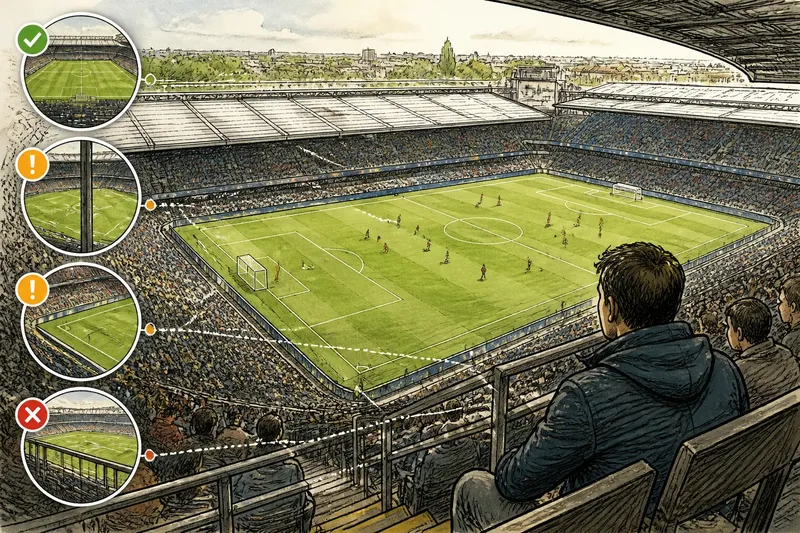
Which seat gives you the perfect stadium view? The answer depends on what you want to notice, not just whether the field is visible. A clear sightline can still leave play hard to read if a roof edge, railing, or steep angle cuts across the scene.
Think of a seat as a frame for the match. Its position changes how the field fits together, how much detail stands out, and where your attention naturally goes. The best fit is the one that makes the parts of the game you care about easiest to follow.
Reading the whole field
To follow formations and passing lanes, look for a position that lets you see relationships across the playing surface. Elevation can make spacing easier to interpret, while a seat near a side’s center can keep both ends of the field within a fairly balanced frame.
That broad view has a trade-off: individual players may look small, and close contests can lose some of their physical detail. If you prefer to watch movement unfold as a pattern, that distance may be useful. If you want the texture of a particular exchange, the panorama may feel detached.
Judging scale and angle
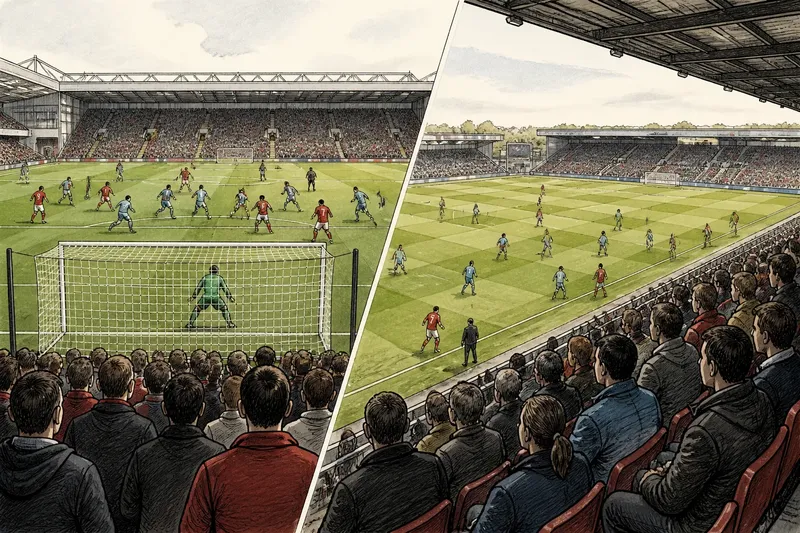
Angle affects how distances appear. From near a corner, players moving toward or away from you may seem to overlap; from a more central position, the field’s width can be easier to compare. Neither view shows every movement with equal clarity.
Scale matters as much as angle. A tight view makes nearby action feel larger, but can make transitions across the field harder to track. A wider view keeps more context in sight, though small movements may be less distinct. Consider whether you tend to follow one area or scan from one end to the other.
Checking seats before booking
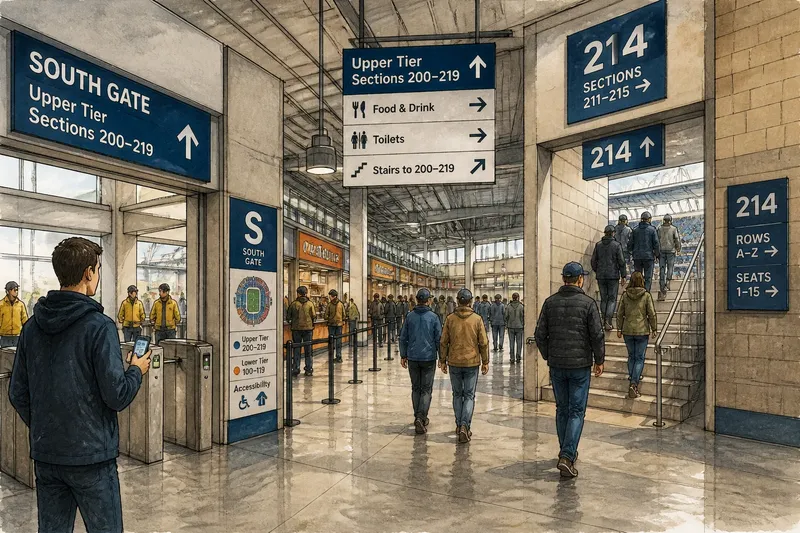
Use the stadium seating map to identify the section’s location, orientation, and elevation. If the venue offers seat-view images or notes, check those for the specific section rather than relying on labels such as “premium” or “center.” An image can clarify perspective, but it may not show every railing, nearby structure, or person in front of you.
- Field coverage: If the map shows a view across most of the playing surface, choose it for broad context; if it shows a narrow angle, compare another section before booking.
- Seat angle: If the seat faces the field more squarely, choose it for balanced perspective; if it sits far toward a corner, choose it only if that angle suits the area you want to watch.
- Elevation: If the section is raised enough to reveal player spacing, choose it for reading patterns; if the view seems too distant, compare a lower section with a similar orientation.
- Obstructions: If the venue notes a post, rail, or restricted view, select a different seat if that object crosses the field; if no obstruction is noted, still inspect any available view image.
- Attention: If you enjoy tracking movement across the full field, choose a position with a broad frame; if you focus on one area, compare seats closer to that region.
- View-image match: If the image shows the angle and height you want, keep that section on your shortlist; if it looks unlike your preferred perspective, check another view rather than trusting the section name.
Say you have two hypothetical options. Seat A is high and near the center, with a view image showing the whole field and no obstruction note. Seat B is lower and near a corner, and its image shows players on the far side partly aligned. You want to follow team shape, so you check the field coverage, angle, and elevation in the map; Seat A fits those priorities. The trade-off is that individual action may look smaller, so if close detail matters more than spacing, Seat B could be the better choice despite its compressed perspective.
It is not worth trying to rank every seat in a stadium from best to worst. A single ranking cannot account for what you want to watch or how much distance and elevation you enjoy.
What should you ask first?
Can a clear view still disappoint?
Yes. An unobstructed seat may still feel too distant, too low, or poorly angled for your preferred way of watching. Check whether the view helps you follow the action, not just whether the field appears in sight.
Does a centered seat matter most?
A central position can make the field’s width easier to read, but it is not automatically the best fit. Choose based on whether you want balanced context or a closer view of a particular area.
How reliable are seat-view images?
They can help you compare elevation and angle, especially when you look at images from the exact section. Treat them as a guide, since they may not capture every obstruction or the view on the day.
Choosing your perspective
The perfect stadium view is not a flawless rectangle of visible field. It is a useful match between seat position and attention: angle for perspective, elevation for context, and distance for the detail you want. When comparing a perfect stadium view, ask what the seat makes easy to understand—and what it puts at the edge of the frame.